
Vitamin C Forms Explained: L-Ascorbic Acid vs Derivatives
L-ascorbic acid vs vitamin C derivatives explained simply, which form is right for your skin, and why the strongest isn't always the best.
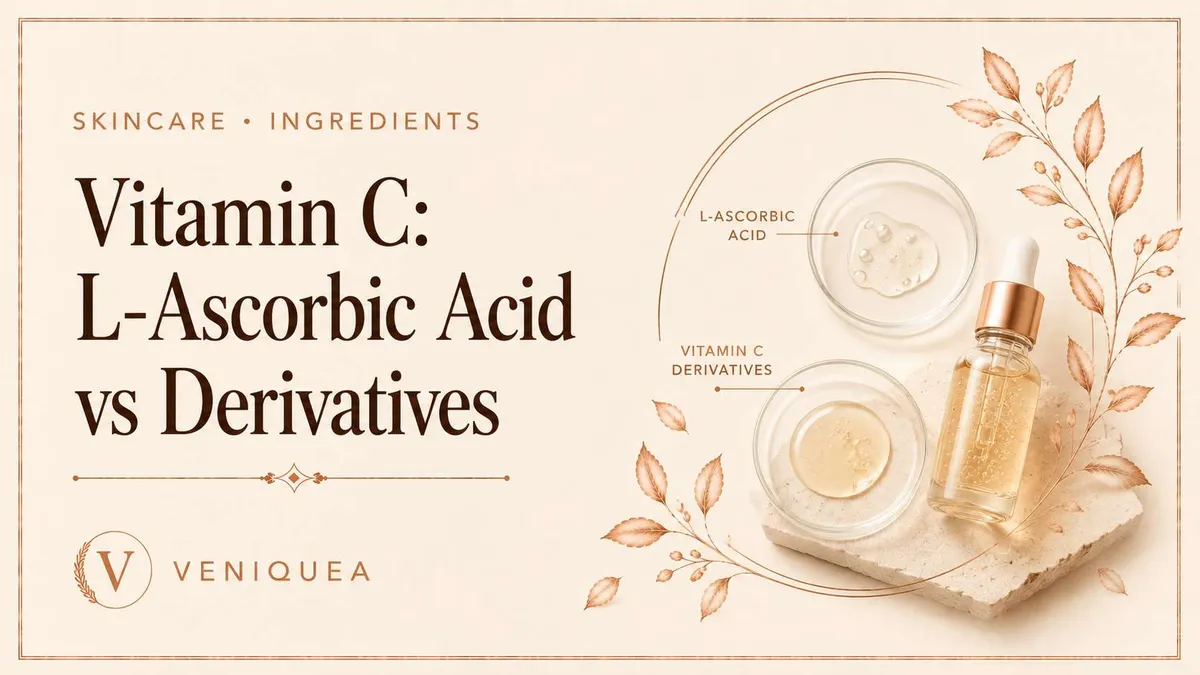
Walk down any beauty aisle or scroll any skincare listing in India and “vitamin C” is everywhere, but it’s rarely the same molecule twice. One serum boasts “20% L-ascorbic acid”, another “10% ethyl ascorbic acid”, a third some branded “vitamin C complex”. These aren’t interchangeable, and understanding the difference is the single most useful thing you can learn before buying a vitamin C serum. The short version: the strongest form isn’t automatically the best one for you, especially in a hot, humid climate.
The two families: pure vitamin C and its derivatives
Vitamin C in skincare comes in two broad groups. The first is pure L-ascorbic acid, the real thing, the form your skin uses directly, and the most researched. It’s potent and effective at brightening, supporting collagen and fighting free radicals. But that power comes with baggage: it’s unstable, prone to oxidising in light, heat and air, and more likely to sting or irritate, particularly at higher strengths.
The second group is derivatives, modified, more stable versions such as ethyl ascorbic acid, sodium ascorbyl phosphate, magnesium ascorbyl phosphate and tetrahexyldecyl ascorbate. These are designed to be gentler and more shelf-stable; the skin converts them toward usable vitamin C. They’re generally less potent gram-for-gram than pure L-ascorbic acid, but far easier to live with, which, for consistent daily use, often matters more than raw strength.
Why derivatives make sense in Indian conditions
Here’s where climate changes the calculation. Pure L-ascorbic acid oxidises faster in heat and humidity, exactly the conditions in most of India for much of the year. A bottle that turns deep orange on your bathroom shelf has lost potency, so you may be applying weaker vitamin C than the label claims. Stable derivatives hold up much better in these conditions, which is a big reason so many popular Indian-market serums are built on ethyl ascorbic acid rather than pure L-ascorbic acid.
Stability isn’t a gimmick. A slightly less potent serum that stays effective through the bottle, in your actual climate, on skin that tolerates it daily, will out-perform a “stronger” serum that oxidised in week three or that you stopped using because it stung.
Strength, and the myth of the biggest number
Percentages get treated like a leaderboard, 20% must beat 10%, surely? Not for everyone. Higher strengths of L-ascorbic acid raise the irritation risk, and beyond roughly 15–20% the added benefit tapers off while the downsides climb. For beginners, sensitive skin, and oily skin managing multiple concerns, a 10% stable derivative is frequently the smarter choice: it brightens reliably, rarely stings, and survives the heat. Save the high-strength pure L-ascorbic acid for skin that has proven it can handle it.
If you want to see this play out in real products, our comparison of the Minimalist 10% derivative serum against the Dot & Key 20% formula shows how form and strength translate into who each serum actually suits.
How to store and use vitamin C well
Whichever form you choose, treat it kindly. Keep the bottle out of direct sunlight, close it tightly after use, and if your home runs hot, the fridge genuinely extends its life. Watch the colour, a strong shift toward orange or brown, especially in an L-ascorbic acid serum, signals oxidation and lost potency. Buy a size you’ll finish in a few months rather than stockpiling. Apply in the morning, wait a minute, then layer moisturiser and, crucially, sunscreen, vitamin C and daily SPF are a team, and neither does its best work without the other.
The practical takeaway: don’t shop by the biggest percentage on the label. Match the form to your skin and your climate. For most people in India starting out, a stable 10% derivative is the sensible, low-drama choice, and our roundup of the best vitamin C serums in India under ₹999 is the place to find one.
Products mentioned in this article
As an Amazon Associate, Veniquea earns from qualifying purchases. We may earn a commission from links below, at no extra cost to you.
Minimalist
Minimalist 10% Vitamin C Face Serum
A 10% stable-derivative serum — an easy, low-irritation first vitamin C.
Dot & Key
Dot & Key Vitamin C + E Super Bright Serum
A higher-strength 20% option for skin already comfortable with vitamin C.
Good to know
Frequently asked questions
Is L-ascorbic acid better than vitamin C derivatives?
It's the most researched and most potent form, but 'better' depends on your skin and your climate. Pure L-ascorbic acid is powerful but unstable and more likely to irritate, and it oxidises quickly in heat and humidity. For many people in India, especially beginners and sensitive skin, a stable derivative delivers steady brightening with far less fuss. The best form is the one you'll use consistently.
What is the most stable form of vitamin C?
Derivatives such as ethyl ascorbic acid, sodium ascorbyl phosphate, magnesium ascorbyl phosphate and tetrahexyldecyl ascorbate are more stable than pure L-ascorbic acid. They resist oxidation better, which matters a lot in hot, humid conditions where L-ascorbic acid can degrade before you finish the bottle. Stability is a big reason many Indian-market serums use derivatives.
How do I know if my vitamin C serum has gone bad?
Colour is the clearest sign, especially for L-ascorbic acid: a fresh serum is usually clear to pale yellow, and as it oxidises it turns deep orange or brown. A strongly discoloured serum has lost much of its potency. Store vitamin C out of direct light and heat, keep it tightly closed, and buy a size you'll finish in a few months.

Research Desk
Veniquea Editorial is the research desk behind this site. We compare formulations and ingredient lists, aggregate verified-buyer feedback, and write up what we find, including the cons. We only say “we tested” when we actually did; everything else is clearly framed as research. Read exactly how we work on our How We Review page.
Keep reading
Related on Veniquea
How to Build a 3-Step Skincare Routine for Oily Skin
A simple, effective 3-step skincare routine for oily skin in India, cleanse, treat and protect, without a ten-product shelf or the shine.
28 June 2026 · 3 min read
Minimalist 10% vs Dot & Key 20% Vitamin C: Which to Buy
Minimalist 10% vs Dot & Key Vitamin C + E serum compared for Indian skin, strength, texture, price and who each one actually suits.
26 June 2026 · 2 min read
Re'equil Ultra Matte Dry Touch Sunscreen SPF 50 Review
An honest review of Re'equil Ultra Matte sunscreen for oily Indian skin, finish, white cast, wear in humidity, and who should skip it.
20 June 2026 · 2 min read